Showing posts with label What Are You Reading?. Show all posts

Friday, February 10, 2017

Read Harder 2017: One book to rule them all?

How's your challenge going? Struggling to find the time to read? (ME TOO.) So, looking to check off a few list items with just one book? We've got you covered!

Check out Lucky Boy by Shanthi Sekaran for four challenges in one book!
Those challenges are:
#2: Read a debut novel. (Sekaran's first!)
#4: Read a book set in Central or South America, written by a Central or South American author. (This is a bit of a stretch but a good portion of the narrative takes place in Oaxaca.)
#5: Read a book by an immigrant or with a central immigration narrative.
#24: Read a book wherein all point-of-view characters are people of color.

While admittedly it gets a teensy bit too sentimental for my liking (heart of stone over here), I think readers will totally fall in love with Sekaran's wonderfully real, flawed, and relatable characters, and the compelling narrative that springs from their (sometimes dubious) life choices.

Solimar, barely 18 and pregnant, has journeyed from rural Oaxaca to California to work for her aunt as a housekeeper. Her situation is tenuous and after a snowballing series of small disasters, seriously in peril. Meanwhile Kavya, a chef in Berkeley, is in her 30s and unable to get pregnant but desperately wants a child. Can you kind of guess where this is going? Their lives and families intersect after a surprising turn of events.

New's Year resolutions are tough. Here's what I'm reading right now:

The Gustav Sonata by Rose Tremain
Selection Day by Aravind Adiga
Guapa by Saleem Haddad
...Because I have to read multiple books at once.

What are YOU reading?

Friday, November 21, 2014

Meta: Reading and Writing about Reading and Writing


I love to read books about reading. I’m not a writer, but I also love to read books about writing, especially if they inform my enjoyment as a reader. Here are a few of my favorites (plus a new one still “on my TBR list”): two about reading and writing fiction, two about reading and writing creative nonfiction, and two about writing in general.

James Wood, Professor of the Practice of Literary Criticism at Harvard University and staff writer for the New Yorker, saw a need for the literary equivalent of John Ruskin’s The Elements of Drawing. He may have filled it with his deceptively slight How Fiction Works (2008).  In concise numbered paragraphs, Wood discusses those elements of modern realist fiction he considers most important, especially narrative style, and most especially the narrative style called “free indirect.” Using examples from Flaubert to David Foster Wallace, he demonstrates its power to let the reader “inhabit omniscience and partiality at once.” New Yorker readers will recognize Wood’s often professorial tone (“But to repeat, what is a character?”) and his sometimes contrary and always certain opinions (“I find this deeply, incorrigibly wrong.”), but the depth of his understanding of and his passion for the modern novel are irresistible.

Francine Prose (what a great name for a writer!) is the author of seventeen novels (including one of this year’s RPL favorites, Lovers at the Chameleon Club, Paris 1932). In her Reading Like a Writer: A Guide for People Who Love Books and for Those Who Want to Write Them (2006), she, too, looks at how fiction works. But Prose is more concerned with the lessons great fiction can offer an aspiring writer. She advocates a return to “close reading”: a word by word, sentence by sentence examination of a writer’s choices and the meaning those choices convey. Appropriately, her book is organized into building-block chapters, beginning with “Words,” “Sentences,” and “Paragraphs.” Chock full of lengthy textual analyses of passages from the greatest authors in English literature, she draws our attention to the craftsmanship that underlies their work.  Although I would not want all my reading to be this close, Prose’s observations have helped me identify what it is about a book that makes it good, or not.


Good Prose: The Art of Nonfiction, further subtitled Stories and Advice from a Lifetime of Writing and Editing, is a collaborative effort by an author, Tracy Kidder, and his editor, Richard Todd, who have worked together since 1973. They discuss three main nonfiction forms -- narrative, memoir, and essay -- and suggest strategies and techniques for each. They also address the ethical issues confronted by nonfiction writers, the challenges of making a living as a writer, and the rapidly changing realm of publishing in an internet age. Although the authors write mostly in a single voice, each also offers his individual perspective and experiences in italicized passages that introduce each section.Good P rose is on its surface a thoughtful how-to for writers of nonfiction, but the evolving relationship of its authors and their appreciation for one another are at its heart.

Chief among the caveats Kidder and Todd offer is, to paraphrase, “Don’t make stuff up.”  They cite the example of essayist John D’Agata, who at the end of his book, About a Mountain, admits that “for dramatic effect” he has changed the chronology of events and conflated characters. This dismays Kidder and Todd, who “can rely on the accuracy of almost nothing we have just read.”


The debate about whether or not a creative nonfiction writer may, or should, alter facts to serve a literary goal is a lively one. Whichever side you favor, The Lifespan of a Fact (2012) is a must-read. Like Good Prose, it is a collaboration, but of a different sort: it is a seven-year email correspondence between the essayist whose reliability is questioned by Kidder and Todd, John D’Agata, and the intern, Jim Fingal, who fact-checked an article of his for the literary magazine Believer.  When Fingal introduces himself and questions a number cited in the piece, D’Agata responds that he doesn’t even think his article, which is about the suicide of a young man in Las Vegas, needs a fact-checker: “I think maybe there’s some sort of miscommunication, because the “article,” as you call it, is fine.”  The book reconstructs, paragraph by paragraph, the original article, sandwiched between the correspondence they agreed to continue in order to debate whether D’Agata owes fealty to the truth while pursuing his art. Between Fingal’s meticulous and sometimes sanctimonious insistence on “fact” and D’Agata’s arrogant conviction that he may disregard it to convey a greater “truth,” it’s hard to like either one of them. Nevertheless, Lifespan of a Fact is a fascinating read, and a valuable contribution to our understanding of the role and responsibilities of creative nonfiction.

I suspect all writers have read or or at some time referred to The Elements of Style, written in 1918 by English professor William Strunk, published in 1935 and updated by E. B. White in subsequent editions in 1959 and 1972. Almost a century old, it was for most of those years the definitive reference for the writer seeking the correct form of a personal pronoun (covered in “Elementary Rules of Usage”) or deciding whether to use “less“ rather than “fewer” (under “Words and Expressions Commonly Misused”). The advice in its “Elementary Principles of Composition” is still sound: “Use the active voice.” “Omit needless words.”  In the last section, “An Approach to Style,” Strunk muses that although being “correct” requires adherence to certain rules, “style” in its broader sense is a more elusive target. Instead of rules, he includes a gentler “List of Reminders”:  “Do not inject opinion.” “Avoid fancy words.” A lot of Strunk and White seems dated, but it is still amusing and helpful. Browse the illustrated version of its fourth edition (2005). Maira Kalman, known for her New Yorker covers and New York Times blogs, adds wit and whimsy with her 57 colorful drawings.

Strunk notes, “Writers will often find themselves steering by stars that are disturbingly in motion,” an observation which brings me to the recently released The Sense of Style: The Thinking Person’s Guide to Writing in the 21st Century, by Harvard psychologist Steven Pinker (The Language Instinct, How the Mind Works). I had hoped to read it before I wrote this post, but other readers got in line ahead of me for the two copies at RPL. Its title suggests, correctly, that it is intended to be kind of an anti-Strunk. Pinker, whose specialties are visual cognition and the psychology of language, believes that language is instinctual: a biological adaptation for communication in a social group.  As such, it is still evolving, however “disturbingly” to purists. Although he acknowledges that some rules are necessary, he shrugs at nitpicks such as (ahem) the use of “like” for “such as.”  An occasional dangling modifier doesn’t alarm him, as long as it does not confuse. He wants us to use science -- modern grammatical theories and research on cognitive psychology -- to understand how rules developed, and recognize when they may be broken. He warns against “The Curse of Knowledge” -- the failure of writers to recognize that their readers may not know all they know.  In some respects he approaches writing like (“as”?) Prose does: word by word. “Good writers acquire their craft not from memorizing rules but from reading a lot, savoring and reverse-engineering good prose, and assimilating vast numbers of words, idioms, tropes, and stylistic habits and tricks.” I can’t wait to get my hands on this book, as soon as I finish rereading Woods and Prose.

Friday, October 03, 2014

Audio Files: The British Invasion

I read an article last week about the resurgence in podcasts, downloadable audio series whose listeners are “committed for 20 minutes” to stories and articles longer than those typically broadcast on the radio.  I laughed at the idea of 20 minutes, since I was four hours into a 12 and a half hour audio book, JoJo Moyes’s One Plus One, a commitment slightly more serious than 20 minutes. So far, it seems to be a more cheerful successor to her also excellent Me Before You. Jess, the single mother of a young daughter who is a math whiz and the stepmother of a teenage victim of bullying, embarks with her family on a road trip to Scotland with the help of a tech millionaire under investigation for insider trading. Several performers give lively voice to its various narrators, in enchanting English accents.


I just finished listening to The Silkworm, by John Galbraith (a. k. a. J. K. Rowling). My J. K. Rowling experience has been all-aural: I listened to every one of the Harry Potter books, entranced by Jim Dale’s narration. I also listened to Rowling’s The Casual Vacancy, which was not particularly well-reviewed. I think if its critics had listened to it instead, they might have been more favorably inclined. As Harry Potter fans know, Rowling has a keen ear for class differences in speech, and British actor Tom Hollander brings out every delicious nuance in this intricate tale of hidden conflict in a small English town. Using the Galbraith pseudonym, Rowling ventured into crime fiction with The Cuckoo’s Calling, featuring unlikely hero Cormoran Strike. A veteran of the war in Afghanistan, Strike returned home minus a leg to try his hand as a private investigator, without much success. His luck changes when he is hired to investigate the apparent suicide of a glamorous model. Strike returns in The Silkworm, this time to solve the grisly murder of an eccentric novelist, whose last manuscript appears to reveal the dirty secrets of Britain’s biggest literary personalities. Rowling’s delicious skewering of the publishing world she knows so well is a cherry on top of a well-crafted whodunit. As in The Casual Vacancy, dialog is everything in both Cormoran Strike books, and how better to appreciate dialog than to listen to it?


My next audiobook is Irish, for a change of pace! Tana French’s The Secret Place, the latest installment of her "Dublin Murder Squad" series, is already on the bestseller lists. Although these dark crime thrillers, each featuring a different detective and a different crime, can be read independently, I think they are best appreciated in order.  Ireland’s changing economic circumstances unfold in the background, and the detectives are seen through each others’ eyes, their backstories revealed slowly. I jumped the queue and listened to Broken Harbor first, and then went back for the first three: In the Woods, The Likeness, and Faithful Place.  All are narrated by well-known Irish actors whose accents are as compelling as the stories they read.
Also on my audio horizon is The Long Way Home, the latest installment in Louise Penny’s series featuring (recently retired) Chief Inspector Gamache. Inspector Gamache is French Canadian, so there’s an accent to be enjoyed here, too, although the series’ award-winning narrator, Ralph Cosham, is English-born, not Quebecois.  A fun bit of trivia about Cosham and Penny: they have never met; nor has Penny ever listened to any of his recordings, for fear that they will influence her own idea of Gamache. And Cosham does not read the books before he records them, so he is as much in the dark as the story progresses as the Inspector and we are.  If Cosham won't read the book, I won’t read the flap!

Friday, August 29, 2014

Quick & Fun: Nonfiction for the Sunbathing Skeptic

Labor Day is here!  If you are going to the beach this weekend, keep in mind that nonfiction can make good beach-reading, too. Unlike the plot of the latest thriller, the lessons taught in these three recent books might outlast your vacation.


Virtual Unreality, by award-winning science journalist Charles Seife, author of Zero, Sun in a Bottle, and Proofiness (a personal favorite), looks at the dark side of the “ultimate information revolution” engendered by the internet and the proliferation of digital information. Internet imposters (“sock puppets”), scams, and hoaxes prey on the even the most sophisticated computer users.  eBooks, print on demand, and digital self-publishing swamp us with e-dross. (Check out Amazon’s 101-page list of “books” by Philip E. Parker.) Wikipedia, aggregation, and other “reporting” phenomena degrade the reliability of information and reinforce error. Filtered newsfeeds and “narrowcasting” by special interest blogs heighten our differences of opinion and validate extremism. Commercial interests use “gamification” and the pressure of social networks to shape our brains and our behavior to their advantage (Farmville players, he’s looking at you.)  There’s more, and Seife’s readable, amusing prose will entertain even as it makes you want to toss your iPhone into the surf.  He ends with a takeaway: “The Top Ten Dicta of the Internet Skeptic”, a practical list of caveats and reminders. My favorite: “Top Ten lists are just marketing gimmicks intended for suckers.”


David J. Hand, professor emeritus of mathematics at Imperial College in London and scientific adviser to a successful algorithmic hedge fund, translates his expertise into a common-sense guide to probability for the layman: The Improbability Principle: Why Coincidences, Miracles, and Rare Events Happen Every Day. That person who won the lottery three times?  The October, 1987 stock market crash?  Abraham Lincoln’s dream that he would be assassinated?  Completely explainable if you understand the “laws” of the Improbability Principle. The Law of Truly Large Numbers, the Law of the Probability Lever, and the Law of Selection respectively predict that such events will indeed occur, and occur more often than we expect.  Hand begins this enlightening and entertaining book by exploring the ideas of “chance”, “fate”, “randomness” and other expressions of the capriciousness of the universe. He follows with an easily graspable introduction to the sometimes counterintuitive mathematics of probability, and continues with chapters on the “laws” that together comprise the Improbabilty Principle. He discusses the way the human brain is wired to look for patterns where none exist and other biases that undermine our ability to acknowledge the principle and its laws. Examples abound, and by the time you finish the book, you will be seeing these laws in action everywhere you look. (A coincidence?) Like Seife, Hand leaves us with practical lessons on how a skeptic might use the principle to discern mistaken predictions, detect fraud and hyperbole, and distinguish what is meaningful from what is merely statistically significant.


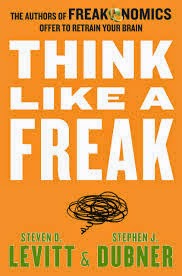
Internet blogs are all about lists (see Seife) and things come in threes (see Hand), so of course I have a third recommendation: Think Like a Freak, by economist Steven D. Levitt and journalist Stephen J. Dubner, authors of the popular Freakonomics and Superfreakonomics.  If you read them, you will recognize their trademark approach to explaining riddles of human behavior:  data-driven, unconventional, often light-hearted, and sometimes controversial.  This time around, the “Freaks” endeavor to teach you the qualities and techniques that make their research so successful. In breezy chapters such as “The Three Hardest Words in the English Language” (hint: they’re not “I love you) and “What’s Your Problem”, they emphasize that scientific problem-solving requires first that you admit you don’t know the answer; and second, that you correctly define the question.  They also include a chapter on how to persuade people of the correctness of your answer (and how to guarantee they won’t listen to you at all) and a final one on knowing when to admit you’re barking up the wrong tree and should quit (my personal favorite!) All of this illustrated by fun stories told with a little bit of snark, many with surprising twists that I won’t give away here. (Why did the band Van Halen require that there be no brown M&M’s in their snack bowls?)


Happy Labor Day!


Friday, August 01, 2014

Man Booker Goes Global

After a too-long hiatus, I’m re-entering the RPL blogosphere to write about books and reading, using my “What Are You Reading?” tag. One of my first posts (in 2010!) was about the Man Booker prize, so it seems appropriate to start out with it this time around as well.


The short list for Great Britain’s Man Booker Prize has always been one of my favorite sources for must-read literary fiction.  Since 1968, the award has been for books written in English by a citizen of The United Kingdom or the Republic of Ireland, but beginning in 2014 it is open to any book written in English and published in the United Kingdom.  Included in the long list of 13 novels released last week are four by Americans, all available at RPL.

You may remember that RPL librarians nominated Karen Joy Fowler’s We Are All Completely Beside Ourselves for the “other” prestigious European literary prize, the International IMPAC Dublin Literary Award. The Man Booker judges agree with us. You may have already read our enthusiastic endorsement, but it bears repeating here:
“Equal parts funny and heartbreaking, Karen Joy Fowler's sixth novel "starts in the middle" and takes the reader back to the murky world of 1970s behavioral psychology experiments through the unreliable memories of a young woman recalling a childhood trauma that drastically altered her and her family.  The novel deftly explores ethics, memory, animal rights issues, and the meaning of family.  With a knockout twist that the author masterfully conceals, We Are All Completely Beside Ourselves is a breathless joy to read.”


Orfeo, by Richard Powers, was blurbed by its publisher as a “man on the run” thriller, perhaps in a commercial appeal to a wider American audience than Powers, author of the 2006 National Book Award winner, The Echo Maker, usually attracts. Peter Els is a 70-year-old composer, retired and largely forgotten. He has the idea that musical patterns can be encoded into the DNA of a bacterium, is mistaken for a bioterrorist by an overzealous Homeland Security Department, and becomes a fugitive.  But this premise is only an excuse: Orfeo is a novel about music and its transcendent possibilities.  Told largely in flashbacks that relate Els’s personal relationships (with his first lover, his ex-wife, a friend and collaborator, and his daughter) as well as his very personal relationship with music, the novel is also an exploration of 20th century music, from Mahler to Steve Reich and beyond. (I found his long descriptive passages of various works best read and and then re-read while listening to the works themselves, which I found on YouTube and in the library.) You don’t have to be a music lover to enjoy Orfeo, but if you’re looking for the thriller promised on the flap, you will be disappointed.

Art is also at the heart (and soul) of Siri Hustvedt’s The Blazing World, my favorite of the four and the best book I have read yet this year.  Like Peter Els, Harriet Burden is an aging artist, also largely ignored and forgotten. Her assemblages received little critical attention in the art world, and her career as an artist was overshadowed by her role as the wife of a famous New York art dealer.  “Harry”, bitter and disillusioned, is convinced that were she a man her art would have received the attention and acclaim it deserves. Following her husband’s death, she tests this hypothesis by undertaking a trilogy of installations and presenting them as the work of three different male artists, who agree to the ruse for their own purposes, and with tragic results. Hustvedt’s ekphrasis* is as successful as Powers’s; her vivid descriptions of Harry’s works are richly imagined and fully convincing. If Orfeo’s structure is a symphony in four movements, The Blazing World is an assemblage of disparate materials -- journal entries, critical reviews, press releases, correspondence and interviews -- collected by an art historian after Harry’s death. Stay with it: the first 50 to 75 pages baffled me, but the compelling heroine and Hustvedt’s piercingly intelligent prose had me fully entranced and engaged thereafter.

Which brings us to Joshua Ferris’s To Rise Again at a Decent Hour. Its first 50 to 75 pages were full of laugh-out-loud promise, but I was completely baffled and fully disengaged by its end.  Paul O’Rourke, a middle-aged dentist in New York City, is a lonely atheist in search of a religious tradition. He’s also a die-hard Red Sox fan, and a Luddite who despises “me-machines” (smart phones) and social media.  O’Rourke is alarmed to discover that someone has created not only a Facebook page for his practice, but an online persona who espouses the beliefs of an obscure sect (the Ulms) whose origins are described in a lost Old Testament book (the Cantaveticles) and whose fundamental tenet is doubting God’s existence.  Got all that?  The novel’s comic beginnings meander into long-winded pseudo-biblical discourse and angst-ridden rumination. I kept reading, but by the time I finished what had become an entirely different book from the one I had begun, I was questioning my own faith in the author’s promise.

Whatever I may have thought of the last, hats off to the Man Booker judges for recognizing this vibrant collection of American literary voices in their first global long list.

* What a great vocabulary word, and where better to use it than a library blog??

Friday, May 30, 2014

Best of May: Joie de Vivre!

Lovers at the Chameleon Club, Paris 1932
Francine Prose

This novel is intoxicating.  Seriously, do not operate any heavy machinery until you are done reading it, which is probably sound advice for life anyway.  Lovers at the Chameleon Club is historical fiction at its most exuberant.  The story of Lou Villars, told through multiple accounts, goes from her debut as a cross-dressing nightclub act to a controversial race car driver to a brutal interrogator for the Gestapo, and takes the reader from the libertine Paris of the 20s, through the depression in the 1930s, and finally into world war.  Along the way we are acquainted with an unforgettable cast of storytelling characters: the powerful but resigned Baroness Lily de Rossignol; caustic American writer Lionel Maine; brilliant Hungarian photographer Gabor Tsenyi and his brave partner Suzanne, teacher and member of the French Resistance, and Yvonne, owner of the Chameleon Club, a refuge as well as a nightclub.


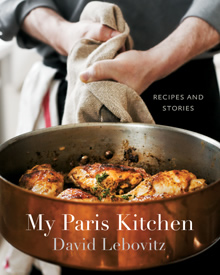
My Paris Kitchen
David Lebovitz

Food blogger David Lebovitz packed up and moved to Paris 10 years ago and this gorgeous book is the result.  Besides 100 recipes to tempt every palate, written in clear, concise instructions even feeble cooks such as myself can proclaim "totally doable", he delights us with stories about life and dining in Paris as an American expat, (like figuring out how and when to serve rosé and the French relationship with air-conditioning) and lush, dreamy photography to compliment the text.  The recipes are modern French classics with an international twist here and there.  You'll find a cassoulet and coc au vin, as well as duck fat cookies and a croque-monsieur (fried ham and cheese sandwich with creamy bread sauce) that I can't wait to try.  


C'est magnifique!

Wednesday, May 08, 2013

Get your passport stamped on another plane this summer (with science fiction!)

I just finished Changing planes by Ursula K. Le Guin and it got me thinking about all the traveling one can do with science fiction without ever leaving the couch or spending a dime (unless you bring your books back late, then it's a dime--still the best deal in town).  I'm also looking for something to get my mind off the creepy invasion of monster underground insects about to happen any day now.  You won't believe how many cicadas are about to envelop the East Coast.  What better distraction than say, reading about creepy invasions of monster insects from other worlds. Am I right?!  So where am I going and where have I just returned from?  Some new places, some old favorites:


Changing Planes: Using Cincinnatian Sita Dulip's method of utilizing the extreme discomfort of traveling through airports to slip off to other planes, one woman visits 15 other worlds and describes interplanary life and leisure.  This book is well worth a visit, in my humble opinion.

Do Androids Dream of Electric Sheep by Phillip K. Dick
Originally published in 1968, this novel served as the inspiration for Blade Runner (1982), which is also an awesome movie.  How often does that happen?

Just go there with him: it's a fantastic journey. I just (finally) read this one and that's all I'm going to say about it.

The Long Earth and The Long War (due out in June) by Terry Pratchett and Stephen Baxter
Another story of interplanary travel, this time from Discworld creator Terry Pratchett.  This was recommended to me by my go-to-sci-fi-librarian-friend so I have high hopes although so far the review from the other side of the sofa is kind of "meh" but we'll see how it turns out.  I have the ebook on my phone.


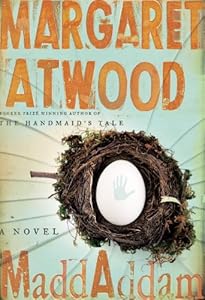
MaddAddam by Margaret Atwood (COMING SOON!)
I can't say enough for this series.  Oryx and Crake and Year of the Flood are two of my favorite books.  I'm so excited for the final book this fall, and I am aware that I have posted about these before thank you.  That's just how good they are.
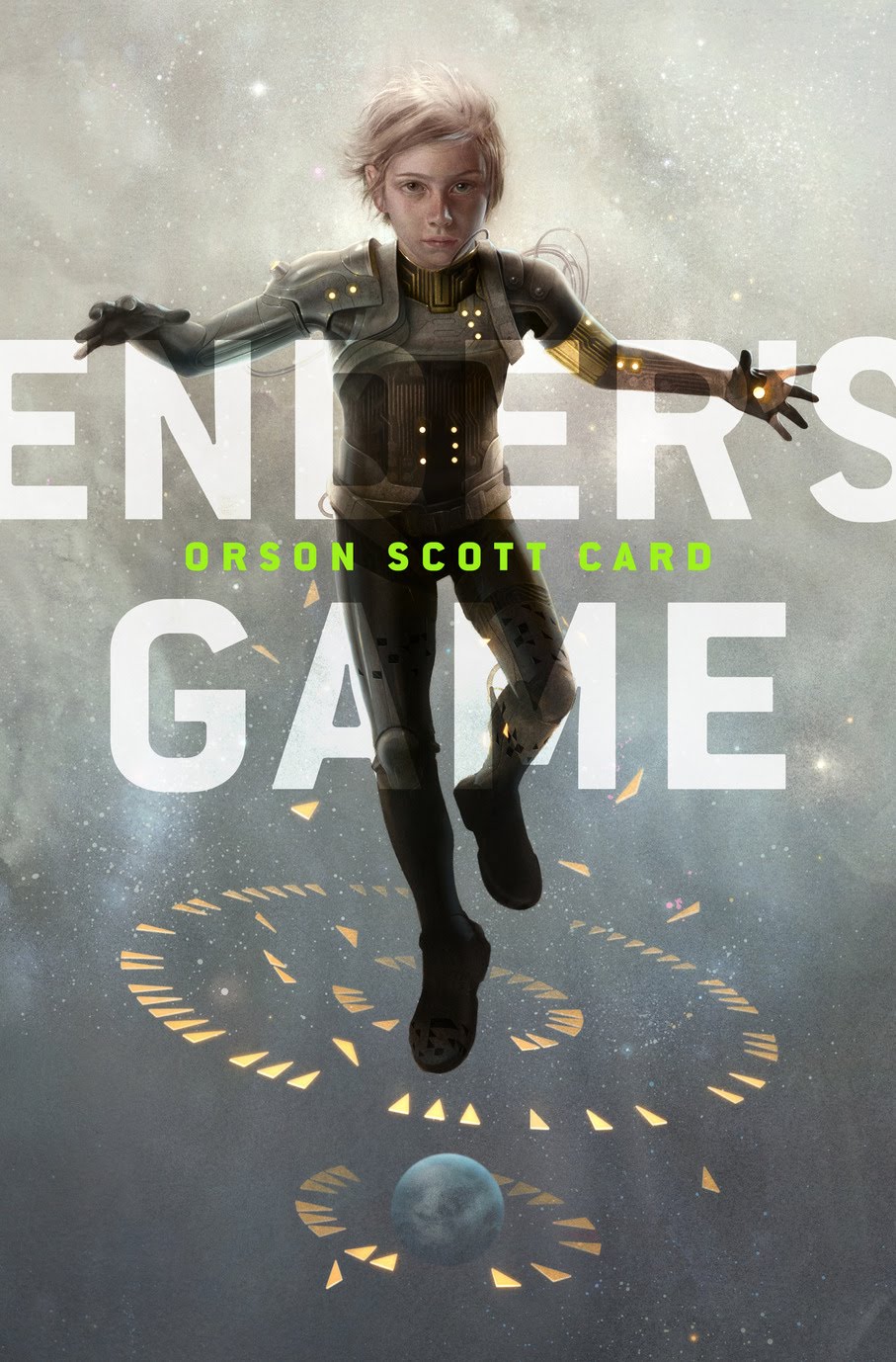
The new film adaptation of Orson Scott Card's Ender's Game is hitting cinemas soon so I need to hurry up and finally read that (Oh shh! I was getting to it!)


The Cave by Jose Saramago.  Not exactly sci-fi though his books often take on supernatural themes and he does such a marvelous job of unsettling the reader by taking them someplace real, but not quite real.   The Double had such a satisfyingly disturbing ending that I can hardly wait to explore The Cave 


Also making me pause to pick it up every time I walk past it, over and over until I finally break down and check it out, (and geez I already have a lot of books checked out) is Pure, the first book in a trilogy of the same name by Julianna Baggott.  I just spied Fuse, which is book two, on the new books shelf.  Here we go again...

Let me just say that I am a fan of the idea of downer vacations: traveling to places far worse than home to make going home feel like a vacation.  Why not travel to a dystopian alternate reality to make us appreciate how few actual zombies we have to deal with in Virginia in 2013?


Tuesday, February 19, 2013

When Writers Write About Themselves

My recent nonfiction reading has included several memoirs by writers. Not authors whose entire oeuvre consists of autobiographical “sharing” of their abused childhoods, or their victories over addiction, or their struggles to meet year-long challenges pitched to their publishers as worth a book. There are way too many of these and, as Neil Genzlinger said in his trenchant New York Times piece, “The Problem With Memoirs,” “we don’t have that many trees left.” These were memoirs by writers who are known for their fiction or journalism or criticism, who had something to say about subjects other than themselves, and who said it well, before they turned to memoir.


Elsewhere, by Richard Russo

I have read and loved every one of Richard Russo’s eight novels, from The Risk Pool through That Old Cape Magic. All but the last take place in New England towns whose industrial heydays have long passed. All of them feature characters striving to escape those towns in a restless quest for happiness. In Russo’s spare and affecting memoir, Elsewhere, those towns are revealed to be his hometown of Gloversville, N.Y., and those restless seekers to be, perhaps, inspired by his mother, Jean. Russo’s unusually close relationship with his rebellious and often unstable mother, and his gradual understanding of her peculiar devils are the heart and soul of this book. The milestones of his literary career are barely mentioned, his marriage only enough to establish the forbearance of his wife, Barbara. Russo explained these absences in an interview with John Williams of the New York TImes: the writer must decide what fits the narrative arc and what doesn’t. The fact that something actually happened doesn’t mean it should be included. A memoirist isn’t free to invent, but the shape of the story is up to him.” If you are a Russo fan, you will enjoy Elsewhere even as you wish he had included more of himself in the story.


One for the Books, by Joe Queenan

It was through his memoir Closing TIme (2009) that I first met Joe Queenan, a columnist and humorist who writes mostly about sports and American pop culture, currently for the Wall Street Journal. His funny, angry and moving account of growing up in a working class Irish neighborhood in Philadelphia is Angela’s Ashes without the forgiveness. It was as a youth trying to escape the wrath of his abusive and alcoholic father that Queenan discovered reading and what has become his lifelong love of books. It is that love that his new collection of essays, One for the Books, celebrates. In it, he describes his eccentric reading habits (dozens of books at a time), his prejudices (nothing written by a Yankees fan or set in a boarding school), and his reverence for the physical fact of a “book” itself (he owns 1,374). Queenan has strong opinions. He skewers many of my own bêtes-noires (book club discussion questions, Middlemarch), but I am also one of “those people . . . who read Jonathan Franzen and Jonathan Safran Foer and Jonathan Lethem and assorted writers named Cölm.” If you love to read and don’t take yourself too seriously, read this book. Be considerate of those in the room with you: your frequent laughter may annoy.


Winter Journal, by Paul Auster

Alas, not all writers make good memoirists. If it hadn’t been the only book I’d taken with me on a weekend trip, I wouldn’t have read past page ten of Paul Auster’s Winter Journal. Written in the annoying second person, it is a self-indulgent slog through an assortment of stream-of-consciousness memories, ranging from the quotidian (every room, apartment or house he has ever lived in) to the sentimental (grade-school crushes) to the existential (the death of his mother and his own aging). The critic James Wood wrote a scathing essay about Auster for the New Yorker, entitled “Paul Auster’s Shallowness” (included in his new collection, The Fun Stuff). In it he says,“There are things to admire in Auster’s fiction, but the prose is never one of them.” There may also be things to admire in Auster’s nonfiction, but I couldn’t get past the prose to find them.


Mortality, by Christopher Hitchens

Auster’s whining about his various physical ailments contrasts sharply with Christopher Hitchens’s unflinching observations about his experiences in “Tumortown.” The incisive and insightful Mortality, written during the year and a half he was “living dyingly” with esophageal cancer, is hard to read, and harder to put down. Whether you agree with his contrarian views or not, you will be dazzled by the clarity of his intellect and moved by the bravery with which he faced his impending death. “Whatever view one takes of the outcome being affected by morale, it seems certain that the realm of illusion must be escaped before anything else.”

Thursday, January 17, 2013

Best Books of 2012 - Readers' Picks

We know what the critics liked in 2012 (see my previous post) but what about us readers?  Are we as discriminating as the critics? Based on the top three best-sellers on Amazon for 2012, apparently not.  I don’t know what the the Fifty Shades of Grey phenomenon says about American (women’s) reading preferences, but the erotic trilogy has made its author and publisher a fortune, and continues to dominate the best-seller lists of eBooks and paperbacks.  Gone Girl was Amazon’s fourth best-selling 2012 title, and J. K. Rowling’s fame landed her first adult novel, The Casual Vacancy, in the fifth spot.


Amazon’s Best-selling Books of 2012
Fiction:

(1-3) Fifty Shades of Grey, Fifty Shades Darker, Fifty Shades Freed, all by E. L. James
Gone Girl, by Gillian Flynn
The Casual Vacancy, by J. K. Rowling
The Racketeer, by John Grisham
Winter of the World: Book Two of the Century Trilogy, by Ken Follett

Amazon’s top-selling 2012 nonfiction included titles seen nowhere among the critics’ notables:

No Easy Day: The Firsthand Account of the Mission That Killed Osama Bin Laden, by Mark Owen with Kevin Mauer
Killing Kennedy: The End of Camelot, by Bill O’Reilly
Proof of Heaven: A Neurosurgeon's Journey into the Afterlife, by Eben Alexander
The Power of Habit: Why We Do What We Do in Life and Business, by Charles Duhigg
Quiet: The Power of Introverts in a World That Can't Stop Talking, by Susan Cain

Goodreads.com, a popular readers’ website, invites its members to pick the People’s Choice awards for the year. Goodreads readers chose these fiction titles:

The Casual Vacancy, by J. K. Rowling
Where We Belong, by Emily Giffen
Home Front, by Kristin Hannah
The Age of Miracles, by Karen Thompson Walker
This Is How You Lose Her, by Junot Diaz


And these general nonfiction titles:


Quiet: The Power of Introverts in a World That Can't Stop Talking, by Susan Cain

Behind the Beautiful Forevers: Life, Death and Hope in a Mumbai Undercity, by Katherine Boo
The Power of Habit: Why We Do What We Do in Life and Business, by Charles Duhigg
Steal Like an Artist: 10 Things Nobody Told You About Being Creative, by Austin Kleon
How Children Succeed: Grit, Curiosity, and the Hidden Power of Character, by Paul Tough


(Memoirs, history, and biography appear in separate lists.)


What about RPL readers?  We compiled a list of 2012 hardcover titles ranked in order of popularity based on the number of checkouts. According to this list, our patrons like crime fiction (thrillers and mysteries) and urban fiction.  The top ten most-circulated titles of 2012 were:

The Innocent, by David Baldacci
Private Games, by James Patterson and Mark Sullivan
11th Hour, by James Patterson and Maxine Paetro
Murderville, “from the minds of” Ashley and Ja (What does that mean???)
Gone Girl, by Gillian Flynn
Low Down and Dirty, by Vicki M. Stringer
Home, by Toni Morrison
Guilty Wives, by James Patterson and David Ellis
An Accidental Affair, by Eric Jerome Dickey
Black and Ugly As Ever, by T Styles

Of the top 50 or so titles that circulated more than 100 times, urban fiction was the most popular genre, with 19 titles. Crime fiction was next with 11. Commercial, or popular, fiction included 11 titles, and literary fiction 5. Only 1 nonfiction title circulated more than 100 times: Cheryl Strayed’s memoir Wild, From Lost To Found on the Pacific Crest Trail.  And where on the list was Fifty Shades of Grey (in a classification all its own)?  16th.