Showing posts with label Novels. Show all posts

Friday, August 26, 2016

The Ridiculous Side of Lists


Anyone who reads knows the value of a list. The personal book list—a list of what you’ve read and of what you want to read—is a map. It can be practical, keeping you from going back to the same place twice (or inspiring you to go back to the same place twice), and helping you on to your next destination. It can also just be fun to make and talk about.

For the past five years an editor at the Observer newspaper has been conducting a giant and provocative experiment in list-making. In 2011 Robert McCrum (author of the fantastic biography Wodehouse) began to list the 100 best novels written in English.

There was no ranking inside the list; it developed chronologically, from 1678—The Pilgrim’s Progress—to a working cut-off point of 2000—True History of the Kelly Gang. The rules were few—only one novel per author—and sometimes vague: what, after all, is a classic? or even a novel? And rather than release the list all at once, each of the 100 selections was announced weekly with a short essay. For two years readers around the world could cheer or balk at the choices, and, when it was all done, wonder how such-and-such a book could possibly be passed over.

The task was, as the Irish Times put it, like “running naked into no-man’s-land with a target painted on your chest and a kick-me sign pinned to your back.” But McCrum embraced all controversy. The Observer invited readers to vent their disagreement with the list, compiled an alternative list based on reader suggestions, and published an essay critiquing the lack of female authors in the list. As McCrum himself wrote, “like all lists, ours is intended to sponsor discussion.”

The list of greatest novels reached it’s 100th novel last year, but in January of this year a new, more Quixotic list began: the 100 best nonfiction books of all time. Some of the rules stayed the same—in English, arranged chronologically—but others only got looser, perhaps to provoke more readers, perhaps to introduce more variety. Instead of restricting itself to one form, like the novel, this list looks at all “essential works of philosophy, drama, history, science and popular culture.” 

So far the Observer has named 30 books on the list, this time working backwards from 2014. Some of them can be a little head-scratching—how is Waiting for Godot nonfiction?—but McCrum isn’t looking for uniformity, nor to mirror your opinions, nor to give an objective view of the literary landscape. “Every thoughtful person must concede that any list is bound to have its ridiculous side,” he writes. 


I think of the word “best” in these lists as a dare and a half-joke. The list serves as an aid for other lists: yours. Already the 30 choices in the nonfiction list have reminded me of things I’ve read and loved (Against Interpretation) and of things I’ve long planned to read (No Logo) and suggested to me fascinating things I’ve never heard of (A Book of Mediterranean Food). So follow along with the Observer with your own book list close-by—on Library Thing or Good Reads or scrawled on a scrap of paper like a recipe. Follow along if you don’t yet have a book list. Follow along only if you want to carpet bomb the Observer with emails about your favorite book. Lists are useful, but they’re also ridiculous and fun.

Friday, April 29, 2016

Get carried away with historical fiction

Us Conductors by Sean Michaels

A couple of months ago Clara Rockmore was featured as the Google Doodle and it got me thinking about this book and how easy it is to get so swept up in historical fiction that you either A) forget that it's fiction, or B) forget that the characters in the fictional account were actually real, or perhaps some combination of A and B resulting in completely losing your grip on reality and slipping through the looking glass. Hasn't that happened to you? Anyway, historical fiction can be powerful stuff, approach with caution.

Winner of the 2014 Scotiabank Giller Prize, Us Conductors is the captivating fictional account of real Russian scientist, spy, and inventor of the theremin, Lev Termen (Leon Theremin) and his muse, electronic music pioneer Clara Rockmore. The story, told through correspondence and flashbacks, speculates about Termen's unrequieted love for Rockmore, and the circumstances surrounding his return to the Soviet Union. Once I finished this beautiful book I couldn't let the story go,  so I immersed myself in YouTube videos and audio recordings of Lev and Clara playing the theremin. Clara Rockmore was a classical violin prodigy from Lithuania. Suffering from tendonitis she was forced to give up her beloved instrument, but was later introduced by Termen to his invention: an electronic musical instrument controlled by gesture. She helped refine the instrument, and defined it as an art form, becoming its most prominent performer. I've included a couple of the videos to pique your curiosity.


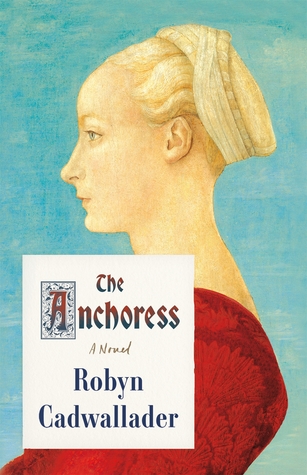
The Anchoress 
by Robyn Cadwallader

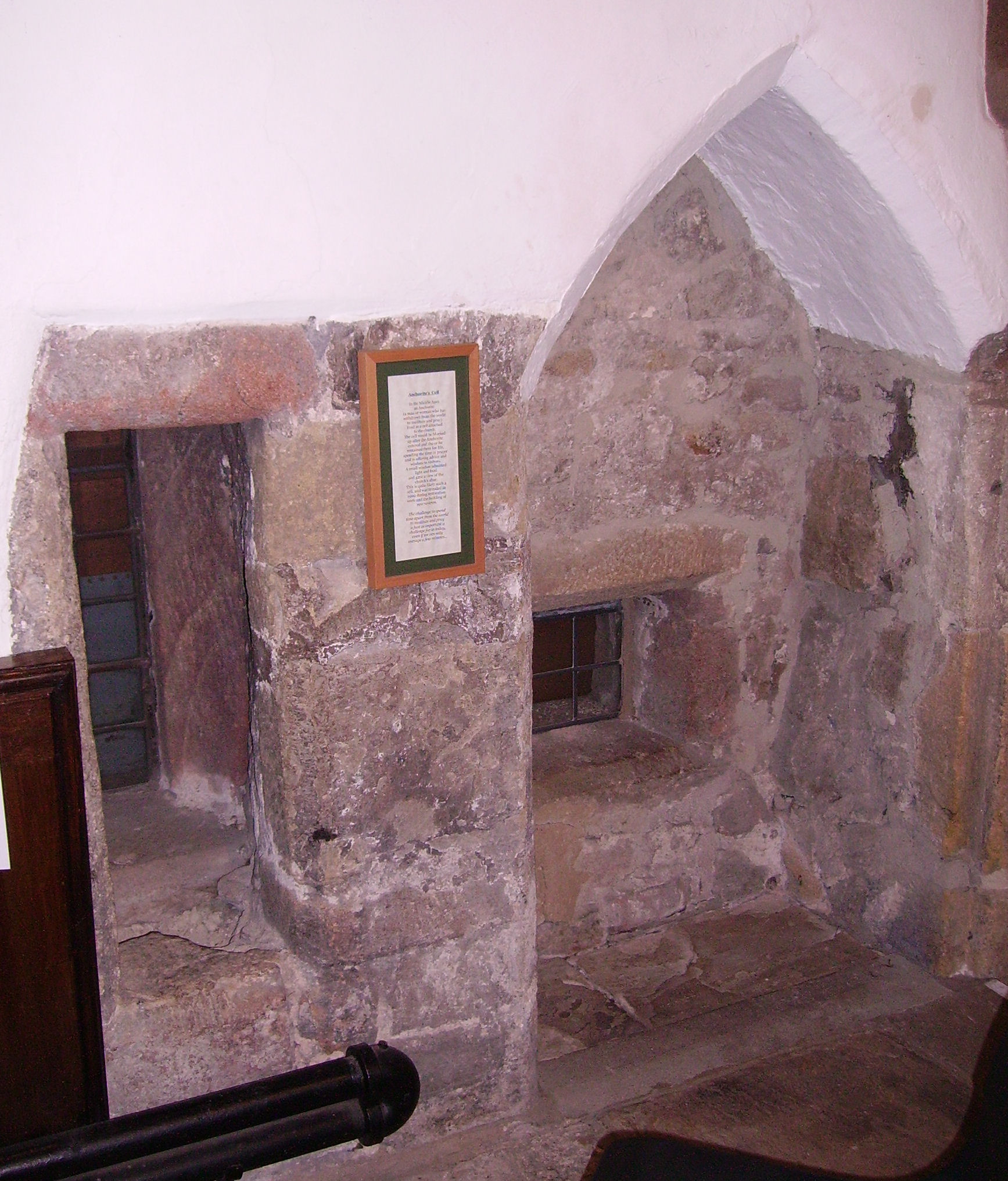
The Anchoress is the fictional account of a (probably fictional) anchoress in 1255 named Sarah. What's an anchoress? Good question! Until a patron recommended this book to me, I admit that I didn't have a clue. Then I did some googling. In Medieval Europe, an anchorite was a religious recluse, someone who would lock themselves away, denying themselves all but the very minimum required for survival. They felt that through complete solitude and denial of all earthly pleasures they were "hanging on the cross with Christ". They would be enclosed for the rest of their lives in a tiny cell adjoined to a church and were a symbol of piety and a source of comfort for their communities, living out their days in contemplative prayer. Author Robyn Cadwallader takes the reader into Sarah's time and culture, her tiny cell, and delves deep into her mind and motivations.
An anchorites' cell in England
In an interview in the Sydney Morning Herald the author describes a point in her PhD research into the life of Saint Margaret: "I came across this word 'anchoress', wondered what it was, started to read a bit more and was absolutely horrified, fascinated, really thought it was just a terrible, terrible thing," she says. "I just kept reading and in a way, it wasn't essential to the thesis, but I was so fascinated by it that I just kept reading." That's what I'm talking about.

Looking for more? Check out Thomas Mallon's recent, well-reviewed Finale: A Novel of The Reagan Years, or The Revenant by Michael Punke (I could go on all day). You'll enjoy exploring the real people or events behind these marvelous fictional tales as much as the tales themselves.

Friday, June 05, 2015

Richmond Upon James: An Unrivalled Landscape


You may know that our fair city, RVA, is believed to be named by William Byrd II after a view of the James River from Libby Hill reminded him a view of the Thames River from a village west of London called Richmond. The curve of the James as it begins its slope down the peninsula does indeed look like the curve of the Thames, as a quick tour of Google maps will confirm. But a tour of the library, its art books and novels, might yield more interesting glimpses of our city’s namesake than you can find in Google Maps, or even by flying to Richmond upon Thames itself. Here are a few works of art depicting the view that so impressed William Byrd. And if Byrd saw England when standing over the James, perhaps you can see Virginia in these portraits of the Thames.


Sir Joshua Reynolds painted The Thames from Richmond Hill in 1788. Reynolds (1723-1792) did not paint many landscapes, but he had excellent access to the view as he lived on Richmond Hill. He was the first president of the Royal Academy in London and delivered several lectures on art still celebrated today.


J.M.W. Turner, exhibited his England: Richmond Hill, on the Prince Regent’s Birthday in 1819. Turner (1775-1851) was a great admirer of Reynolds, requesting even to be buried beside him. He too lived close to the view and completed many drawings of it. Turner was recently the focus of a feature film, Mr. Turner, in which he stumbles his way through the gorgeous landscapes seen in his paintings.

In 1879, Charles Dickens, Jr., eldest son of the Charles Dickens you’ve heard of, wrote in his Dictionary of the Thames: “Nothing in the neighborhood of London is better known or more delightful than the view from Richmond Hill and Terrace, and when Sir Walter Scott described it as an unrivalled landscape, he was hardly saying too much.” Dickens was referring to a passage in Scott’s novel The Heart of Midlothian, which was published a year before Turner exhibited his painting. In the novel, a young woman named Jeanie Deans walks from Scotland to London to appeal to the Queen on behalf of her wrongly-accused sister. Here, Jeanie steps out of the Duke of Argyll’s coach and admires the view that Turner, Reynolds, and William Byrd II had admired.

“The carriage rolled rapidly onwards through fertile meadows, ornamented with splendid old oaks, and catching occasionally a glance of the majestic mirror of a broad and placid river. After passing through a pleasant village, the equipage stopped on a commanding eminence, where the beauty of English landscape was displayed in its utmost luxuriance. Here the Duke alighted, and desired Jeanie to follow him. They paused for a moment on the brow of a hill, to gaze on the unrivalled landscape which it presented. A huge sea of verdure, with crossing and intersecting promontories of massive and tufted groves, was tenanted by numberless flocks and herds, which seemed to wander unrestrained and unbounded through the rich pastures. The Thames, here turreted with villas, and there garlanded with forests, moved on slowly and placidly, like the mighty monarch of the scene, to whom all its other beauties were but accessories, and bore on its bosom an hundred barks and skiffs, whose white sails and gaily fluttering pennons gave life to the whole.”