Showing posts with label Richmond history. Show all posts

Friday, September 11, 2015

Author talk @ RPL: Excerpt from Dr. Harry M. Ward's Children of the Streets of Richmond, 1865-1920

Dr. Harry M. Ward will be discussing his latest book, Children of the Streets of Richmond, 1865-1920, at the Main Library on Monday, September 14th at 6 pm. Call 804-646-7223 to RSVP! 

The following excerpt from chapter one comes from a reporter's 1896 description of his tour of Richmond's "neglected region". 

As I read the following text I wondered about the impression our visitors will take away from their experiences on the very same streets of Richmond during the upcoming UCI Championships, almost 120 years later-- Quite a different scene to be sure. 

(The reported "vile spot" teeming with "brazen women", "cheap drinks, cheap theatres, and cheap lodging" is approximately the area of the 17th Street Farmer's Market.)

Ya know...this lovely place. 


Excerpt from Chapter 1:


From Children of the Streets of Richmond, 1865–1920 ©
2015 Harry M. Ward by permission of McFarland & Company, Inc., Box 611, Jefferson NC
28640. www.mcfarlandpub.com.

Friday, June 05, 2015

Richmond Upon James: An Unrivalled Landscape


You may know that our fair city, RVA, is believed to be named by William Byrd II after a view of the James River from Libby Hill reminded him a view of the Thames River from a village west of London called Richmond. The curve of the James as it begins its slope down the peninsula does indeed look like the curve of the Thames, as a quick tour of Google maps will confirm. But a tour of the library, its art books and novels, might yield more interesting glimpses of our city’s namesake than you can find in Google Maps, or even by flying to Richmond upon Thames itself. Here are a few works of art depicting the view that so impressed William Byrd. And if Byrd saw England when standing over the James, perhaps you can see Virginia in these portraits of the Thames.


Sir Joshua Reynolds painted The Thames from Richmond Hill in 1788. Reynolds (1723-1792) did not paint many landscapes, but he had excellent access to the view as he lived on Richmond Hill. He was the first president of the Royal Academy in London and delivered several lectures on art still celebrated today.


J.M.W. Turner, exhibited his England: Richmond Hill, on the Prince Regent’s Birthday in 1819. Turner (1775-1851) was a great admirer of Reynolds, requesting even to be buried beside him. He too lived close to the view and completed many drawings of it. Turner was recently the focus of a feature film, Mr. Turner, in which he stumbles his way through the gorgeous landscapes seen in his paintings.

In 1879, Charles Dickens, Jr., eldest son of the Charles Dickens you’ve heard of, wrote in his Dictionary of the Thames: “Nothing in the neighborhood of London is better known or more delightful than the view from Richmond Hill and Terrace, and when Sir Walter Scott described it as an unrivalled landscape, he was hardly saying too much.” Dickens was referring to a passage in Scott’s novel The Heart of Midlothian, which was published a year before Turner exhibited his painting. In the novel, a young woman named Jeanie Deans walks from Scotland to London to appeal to the Queen on behalf of her wrongly-accused sister. Here, Jeanie steps out of the Duke of Argyll’s coach and admires the view that Turner, Reynolds, and William Byrd II had admired.

“The carriage rolled rapidly onwards through fertile meadows, ornamented with splendid old oaks, and catching occasionally a glance of the majestic mirror of a broad and placid river. After passing through a pleasant village, the equipage stopped on a commanding eminence, where the beauty of English landscape was displayed in its utmost luxuriance. Here the Duke alighted, and desired Jeanie to follow him. They paused for a moment on the brow of a hill, to gaze on the unrivalled landscape which it presented. A huge sea of verdure, with crossing and intersecting promontories of massive and tufted groves, was tenanted by numberless flocks and herds, which seemed to wander unrestrained and unbounded through the rich pastures. The Thames, here turreted with villas, and there garlanded with forests, moved on slowly and placidly, like the mighty monarch of the scene, to whom all its other beauties were but accessories, and bore on its bosom an hundred barks and skiffs, whose white sails and gaily fluttering pennons gave life to the whole.”


Friday, January 30, 2015

The Art of Berkeley Williams Jr.

From 1920 to 1975 the Richmond Public Library clipped and indexed every newspaper article it could find on local art exhibitions. The library may have stopped cutting and pasting, but the clippings, in 36 binders, are still available for perusal at the main library’s reference desk. The articles provide an immediate sense of the RVA art scene of the early 20th century and can uncover fascinating, unheard of artists, sending you on a chase through the library’s collections.

After a quick thumb through one of the binders I stopped on this striking image:


The illustration--a sinister-looking dandy stalking the streets with cape and cane--is by Berkeley Williams, Jr., and it accompanied a review of Williams work shown on East Franklin Street in 1927. The write-up is glowing, almost equaling its subject in style: “whether one be artist or bootblack, poet or porter, one cannot look upon the pictures without getting the hunch that there is glamor in this living business.”

Williams, it turns out, makes a few appearances among the library’s early clippings. In 1930 Williams showed thirty of his paintings in Richmond, still-lives and landscapes painted in Southern France. A review of that show explained that Williams, a Richmond-native, studied at the Pennsylvania Academy of the Fine Arts before spending 18 months in France. He then returned home with his work, giving Richmond one of its first tastes of modern painting. Another article just under two years later declared: “Mr. Williams has reached the point where he is convincing in everything he does.”

Portrait of Hunter Stagg (1931)
Still curious, I switched over to the library’s old file of local obituaries. With the help of a reference librarian I discovered that Williams died in 1977 at 72 years old. He attended St. Christopher’s School in Richmond and the University of Virginia. He married Alta Murdoch “Jerry” Williams, the garden columnist for the Times-Dispatch. And his creative output did not stop with the early 1930s paintings. Williams went on to work as an illustrator for children’s books, collaborating on two collections of Appalachian folk tales, both held by the library, The Jack Tales and Grandfather Tales.


So far I had learned about Williams’ drawings, paintings, and children’s book illustrations, hopping from one collection to another. But I wanted to see the artist himself, and a quick internet search retrieved not only a photo of Williams but brought me right back to First and Franklin. A 1936 Times-Dispatch article preserved online explained that Williams once kept a studio in what was then called Richmond’s Greenwich Village, four brick houses rented out to artists and standing opposite the main library.


For Richmond history, sparkling criticism, and arresting images, stop by the reference desk to see the library’s collection of exhibition clippings. And if you happen to have more information about Berkeley Williams, Jr. please drop us a line or a comment below. We’d love to keep filling in this portrait of a Richmond artist.

Monday, September 16, 2013

The People's Library Project Opening


The People's Library Project is a collaborative, sustainable, and interactive community art project spearheaded by Courtney Bowles and Mark Strandquist.  The project opening is this Friday evening, and we hope you will join us to take part and protect our histories.

From the project website (http://www.nomovement.com/People-s-LIbrary):

"The People's Library* is an ongoing collaborative project featuring libraries designed, built and authored by community members. The project transforms and re-purposes discarded books into blank canvasses for the production and exchange of local histories.
In Richmond, VA, at the Main Branch of the Richmond Public Library, a thousand blank books are being created for anyone in the community to check out, bring home, fill with their histories and bring back to the library to be included in the permanent collection. The resulting installation includes a thousand micro-monuments, becomes the real and symbolic meeting place for alienated publics, and offers sustainable, collective and critical alternatives for the form and function of public art.
While in some instances, public spaces and institutions have invited patron participation, it is often through internet based means. People's Library champions collective production as an avenue for face to face interaction between diverse publics. The project reflects the histories, needs, desires of local residents, and re-interprets public institutions as a space for production, meditation, and alternative education.
Individuals in youth programs at each library will co-facilitate a series of workshops. At each workshop, which are free and open to the public, participants will complete various tasks, engage in conversation about contemporary art, and learn functional creative skills[.]"

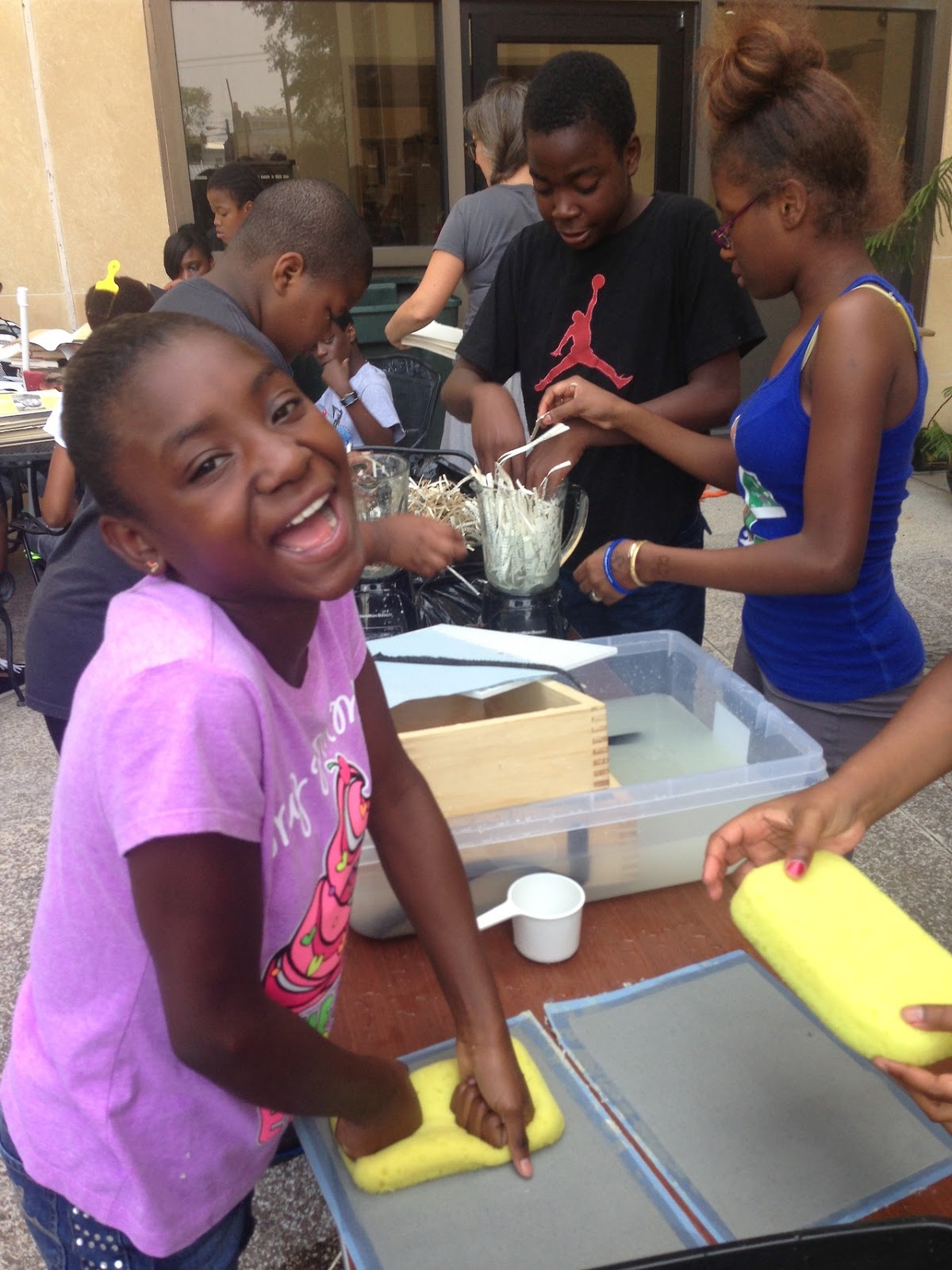
I had the pleasure of being present at one of the paper-making workshops with Mark and Courtney, and was impressed with their skill in working with young people.  So many pages were made, everybody had fun and got their hands dirty (almost everybody that is- I didn't want to stain my clothes, so I just took pictures!  Those are below).

Courtney and Mark were natural teachers.  I have witnessed their ability to articulate their project and its goals to children and adults alike, and this clarity and ease of expression, I think, underscores their passion and commitment to this project and the Richmond community.

So again - please join us this Friday 9/20 for the opening of the People's Library Project.  And stay tuned for more People's Library programming this November at Richmond Public Library!


Friday, August 03, 2012

Improved Access to Richmond School Yearbooks


Ladies and gentlemen! Our Richmond History Collection has moved and has some new (but kind of old) additions!


Now located just next to its old location near the history non-fiction, the Richmond History Collection  has some room to grow and stand up straight. This collection is for reference use only in the library (the books cannot be checked out), and it's an excellent resource for local history researchers. 


The newest additions to the collection are high school yearbooks from around the city. These schools include John Marshall H.S., George Wythe H.S., Huguenot H.S., Thomas Jefferson H.S., Collegiate School, St. Catherine’s School, and St. Christopher’s School. Our earliest yearbook dates back to 1916. We have had many of these yearbooks in the library for decades, but they have finally been added to our catalog thanks to Laura Buell, our wonderful summer intern and a library science student
 

Our collection still needs a little help. We have depended on donations from our supporters to build this collection, and we are looking for more generous donors to help us add more yearbooks. Any yearbook donations are sure to be enjoyed by library visitors for years to come. We will accept old yearbooks or newer ones, as long as they're from a Richmond City school.
Please bring any yearbook you'd like to donate to the Main Library reference desk and a library staff member will have you fill out a yearbook donation form. 


Be sure to take a look at the yearbooks we've collected so far next time you're at the Main Library!  They are really fun to look at and can be wonderful tools for genealogists.

Wednesday, January 04, 2012

Benjamin Campbell at the Main Library this Friday

This Friday, Church Hill resident Benjamin Campbell will be at the Main Library at 7 pm to discuss his book, Richmond's Unhealed History.

A summary of the book from the publisher's website confirms that this will be a lively and interesting discussion of our city's tumultuous history and its potential as a model for healing and reconciliation:
In a detailed look at the history of Richmond, Benjamin Campbell examines the contradictions and crises that have formed the city over more than four centuries. Campbell argues that the community of metropolitan Richmond is engaged in a decisive spiritual battle in the coming decade. He believes the city, more than any in the nation, has the potential for an unprecedented and historic achievement. Its citizens can redeem and fulfill the ideals of their ancestors, proving to the world that race and class can be conquered by the deliberate and prayerful intention of honest and dedicated citizens. (Brandylane Publishers)
This event is sponsored by the Friends of the Richmond Public Library as part of the Richmond Writers Series. Books will be available for purchase and signing. The discussion will take place as part of our monthly First Friday art exhibit openings. This will be a great opportunity to see some art and learn something new about your city.